
Category menu
Gastrointestinal Symptoms and Mental Wellbeing in Neurodivergent and Neurotypical Adults
Posted on 15 July 2026 by Pippa McClounan

Share
from London Metropolitan University
Could gut health affect mental wellbeing in neurodivergent adults?
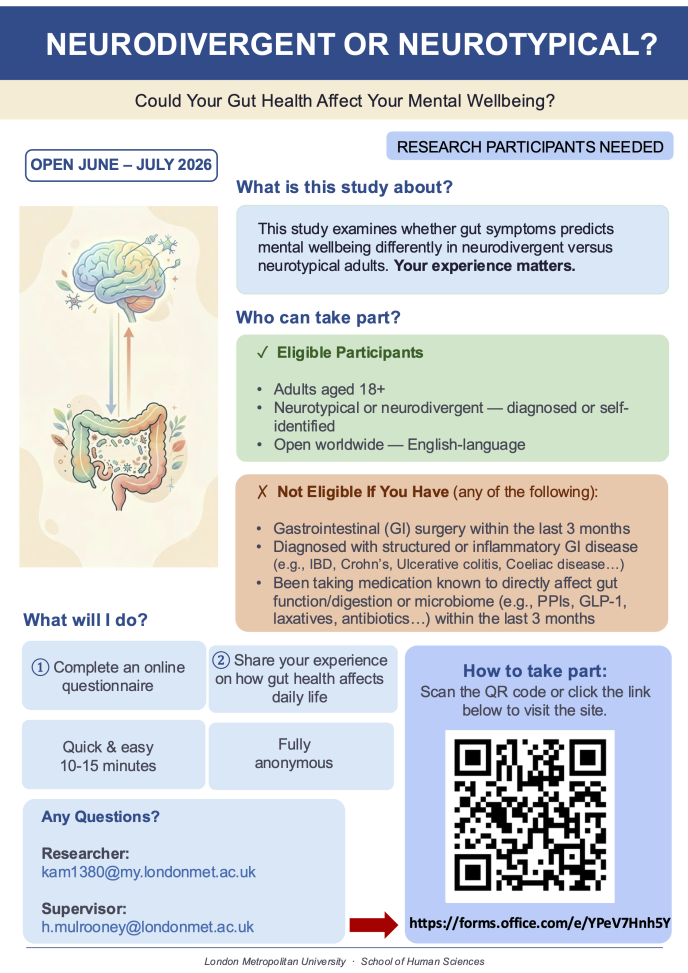
Many neurodivergent people, including those with Tourette syndrome, ADHD, autism, dyslexia, and dyspraxia, experience tummy and digestive problems such as bloating, stomach pain, constipation, or diarrhoea more often than the general population. At the same time, neurodivergent people are more likely to experience low mood, anxiety, and other mental health difficulties. What we don't yet know is whether these two things are connected and whether gut symptoms are linked to mental wellbeing more strongly for neurodivergent people than for neurotypical people.
Understanding whether the gut and mind are connected in this way matters because it could open the door to simpler, everyday support. If gut symptoms turn out to be closely tied to how people feel mentally, it strengthens the case for gut-friendly dietary approaches as one practical way to help people feel better, alongside, not instead of, existing care. It also helps make the point that the physical health of neurodivergent people deserves more attention, not less.
The findings will be written up as a university dissertation, and a plain-language summary will be shared so that participants and the wider community can see what was learned. By taking part, people with tics and Tourette syndrome can help build evidence that reflects their real experiences and could shape more joined-up, person-centred support in the future.
What's involved?
- Completing a short anonymous online survey
- Sharing information about digestive symptoms and mental wellbeing
- Participation at a time that suits you
By taking part, you'll be contributing to research that aims to improve understanding of health and wellbeing across diverse communities.
Why participate?
Your contribution could help improve understanding of the connections between physical and mental wellbeing in both neurodivergent and neurotypical adults.
Who can take part?
- Adults aged 18 years and over
- Neurodivergent adults (including people with Tourette syndrome, ADHD, autism, dyslexia, dyspraxia and dyscalculia)
- Neurotypical adults
Click here to find out more and take part
 Return to news


